
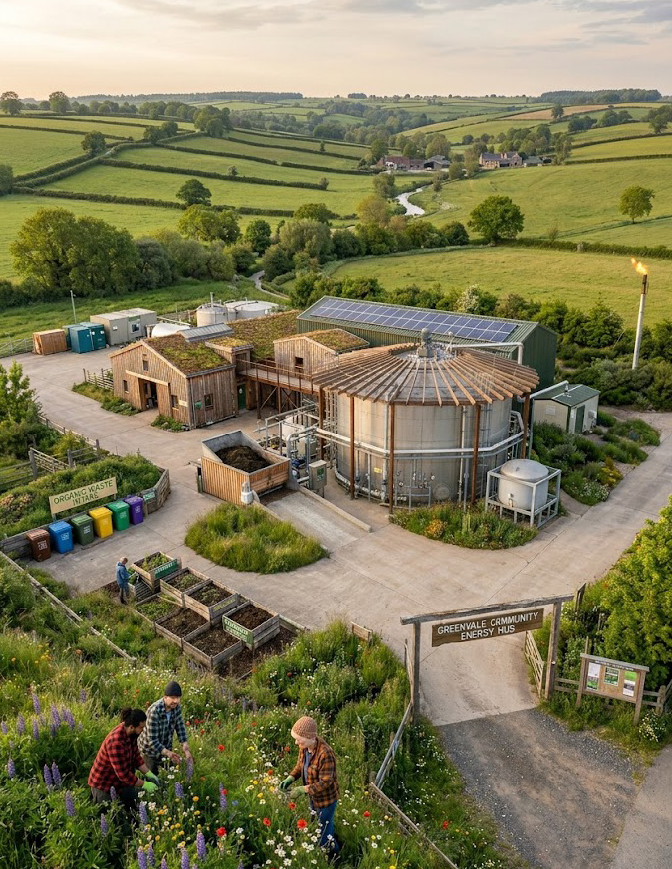
The green biogas cycle: microalgae and bacteria transforming waste into local well-being
Keywords:
Biogas, biological treatment, microalgaeAbstract
Biogas produced through anaerobic digestion requires the removal of contaminant gases to improve its energy quality and reduce environmental impacts. Biological treatment based on microalgae–bacteria consortia enables the removal of these contaminants through complementary biological interactions, improving biogas composition. This technology benefits communities by valorizing organic waste and generating clean energy at low operational costs. Its implementation in rural agro-livestock systems contributes to energy self-sufficiency, reduces pollutant emissions, and generates economic, environmental, and social benefits.
References
Huynh Nhut, H., Le Thi Thanh, V., & Tran Le, L. (2020). Removal of H₂S in biogas using biotrickling filter: Recent development. Process Safety and Environmental Protection, 144, 400–416. https://doi.org/10.1016/j.psep.2020.07.011
Atelge, M. R., Eraydin, A., Senol, H., Diaaeddin, M., Hanif, T., Rais, D. M., Abdulaziz, A., Eskicioglu, C., Muratçobanoğlu, H., Ünalan, S., Kalloum, S., Azbar, N., & Kıvrak, H. D. (2021). A critical overview of the state-of-the-art methods for biogas purification and utilization processes. Sustainability, 13(20), 11515. https://doi.org/10.3390/su132011515
Hoyos, E. G., Lomanar, M. L., Blanco, S., Lebrero, R., & Muñoz, R. (2025). Improving photosynthetic biogas purification via process aeration and nanoparticle supplementation. Bioresource Technology, 418, 131987. https://doi.org/10.1016/j.biortech.2024.131987
Zabed, H. M., Akter, S., Yun, J., Zhang, G., Zhang, Y., & Qi, X. (2020). Biogas from microalgae: Technologies, challenges and opportunities. Renewable and Sustainable Energy Reviews, 117, 109503. https://doi.org/10.1016/j.rser.2019.109503
Sheaffer, C., & Rosen, C. (2024, marzo). Harvesting corn stover. University of Minnesota Extension. https://blog-crop-news.extension.umn.edu/2024/03/harvesting-corn-stover.html
Dirección General de Sistemas de Información Agroalimentaria y Pesquera (DGSIAP). (s. f.). Anuario estadístico de la producción agrícola. Secretaría de Agricultura y Desarrollo Rural. Recuperado el 15 de diciembre de 2025, de https://nube.agricultura.gob.mx/cierre_agricola/
Department of Agricultural Resources in a Grant to the Commonwealth of Massachusetts. (s. f.). Manure inventory. Center for Agriculture, Food, and the Environment, University of Massachusetts Amherst. Recuperado el 15 de diciembre de 2025, de https://www.umass.edu/agriculture-food-environment/crops-dairy-livestock-equine/fact-sheets/manure-inventory
Longinos-Juárez, M. (2024). Biofiltración alcalina de H₂S contenido en biogás empleando un consorcio de microalga-bacteria [Tesis de maestría, Universidad Nacional Autónoma de México]. Repositorio de Tesis UNAM. https://tesiunamdocumentos.dgb.unam.mx/ptd2024/abr_jun/0856458/Index.html
Downloads
Published
How to Cite
Issue
Section
License
Copyright (c) 2026 Revista de divulgación científica iBIO

This work is licensed under a Creative Commons Attribution-NonCommercial-NoDerivatives 4.0 International License.
Self-archiving or deposit of the works in their post-publication version (editorial version) is permitted in any personal, institutional or thematic repository, social or scientific networks. The above applies from the moment of publication of the article in question on the website of the Revista de divulgación científica iBIO.