
The AhR, beyond of the toxicity protein
Keywords:
Aryl hydrocarbon receptor, AhR, environmental toxicology, natural compoundsAbstract
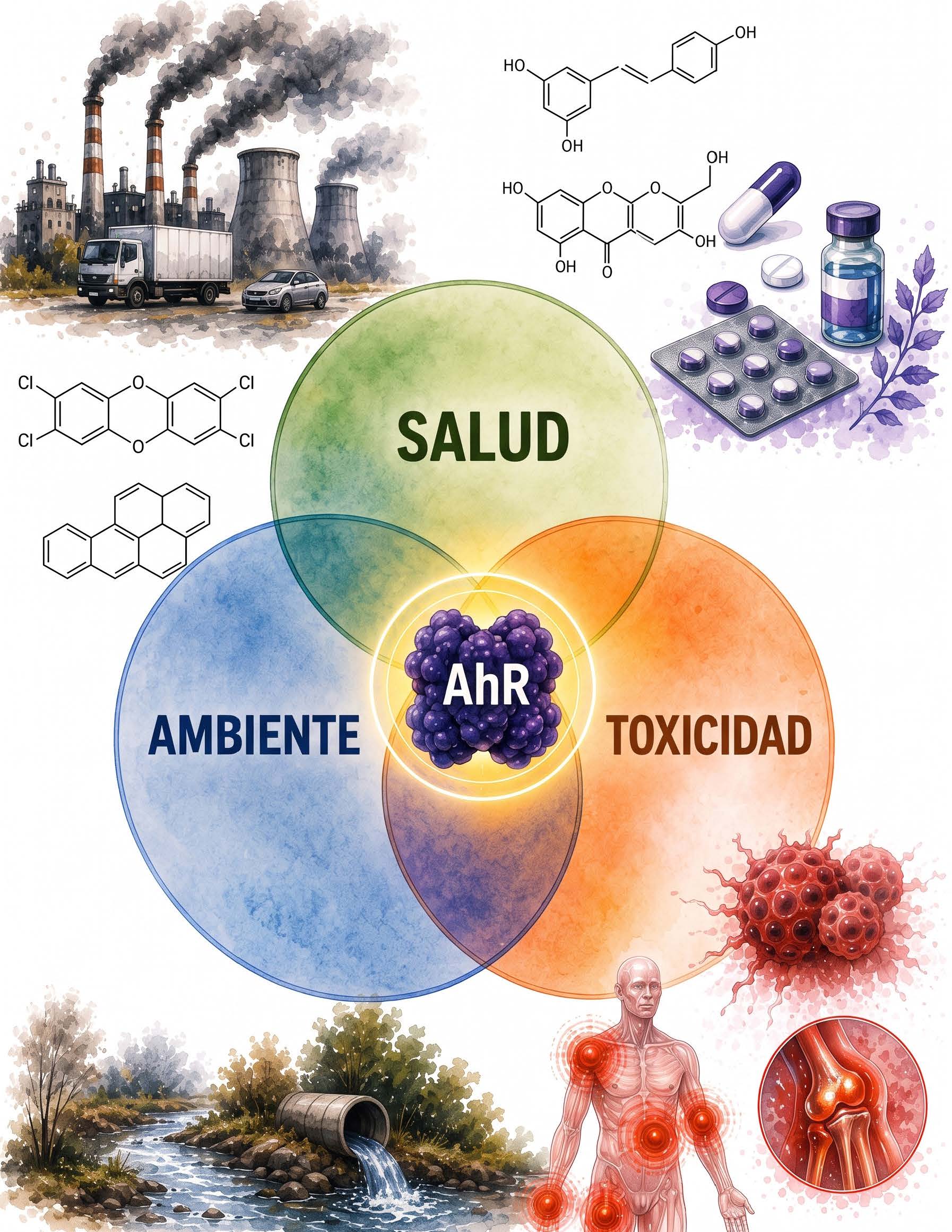
The AhR is a protein present in all cells of our organism. Initially, it was believed that its only function was to induce the toxic effects of chemical substances to which humans are daily exposed. Today, it is known to have other functions essential for normal development and the proper function of our organs and tissues. Recent research has proposed AhR as a promising target for biotechnology for the diagnosis and treatment of disease.
References
Hahn, M. E., Karchner, S. I., & Merson, R. R. (2017). Diversity as opportunity: Insights from 600 million years of AHR evolution. Current Opinion in Toxicology, 2, 58–71. https://doi.org/10.1016/j.cotox.2017.02.003
Vogel, C. F. A., Van Winkle, L. S., Esser, C., & Haarmann-Stemmann, T. (2020). The aryl hydrocarbon receptor as a target of environmental stressors – Implications for pollution mediated stress and inflammatory responses. Redox Biology, 34, 101530. https://doi.org/10.1016/j.redox.2020.101530
De Juan, A., & Segura, E. (2021). Modulation of Immune Responses by Nutritional Ligands of Aryl Hydrocarbon Receptor. In Frontiers in Immunology (Vol. 12). Frontiers Media S.A. https://doi.org/10.3389/fimmu.2021.645168
Fernandez-Salguero, P., Pineau, T., Hilbert, D. M., McPhail, T., Lee, S. S. T., Kimura, S., Nebert, D. W., Rudikoff, S., Ward, J. M., & Gonzalez, F. J. (1995). Immune System Impairment and Hepatic Fibrosis in Mice Lacking the Dioxin-Binding Ah Receptor. Science, 268(5211), 722–726. https://doi.org/10.1126/science.7732381
Lahvis, G. P., Lindell, S. L., Thomas, R. S., McCuskey, R. S., Murphy, C., Glover, E., Bentz, M., Southard, J., & Bradfield, C. A. (2000). Portosystemic shunting and persistent fetal vascular structures in aryl hydrocarbon receptor-deficient mice. Proceedings of the National Academy of Sciences, 97(19), 10442–10447. https://doi.org/10.1073/pnas.190256997
Varela-Silva, J. A., Martínez-Leija, M. E., Orta-García, S. T., Pérez-Maldonado, I. N., López, J. A., Hernández-López, H., González-Amaro, R., Calderón-Aranda, E. S., Portales-Pérez, D. P., & Salgado-Bustamante, M. (2022). Differential Expression of AhR in Peripheral Mononuclear Cells in Response to Exposure to Polycyclic Aromatic Hydrocarbons in Mexican Women. Toxics, 11(1), 28. https://doi.org/10.3390/toxics11010028
Downloads
Published
How to Cite
Issue
Section
License
Copyright (c) 2026 Revista de divulgación científica iBIO

This work is licensed under a Creative Commons Attribution-NonCommercial-NoDerivatives 4.0 International License.
Self-archiving or deposit of the works in their post-publication version (editorial version) is permitted in any personal, institutional or thematic repository, social or scientific networks. The above applies from the moment of publication of the article in question on the website of the Revista de divulgación científica iBIO.