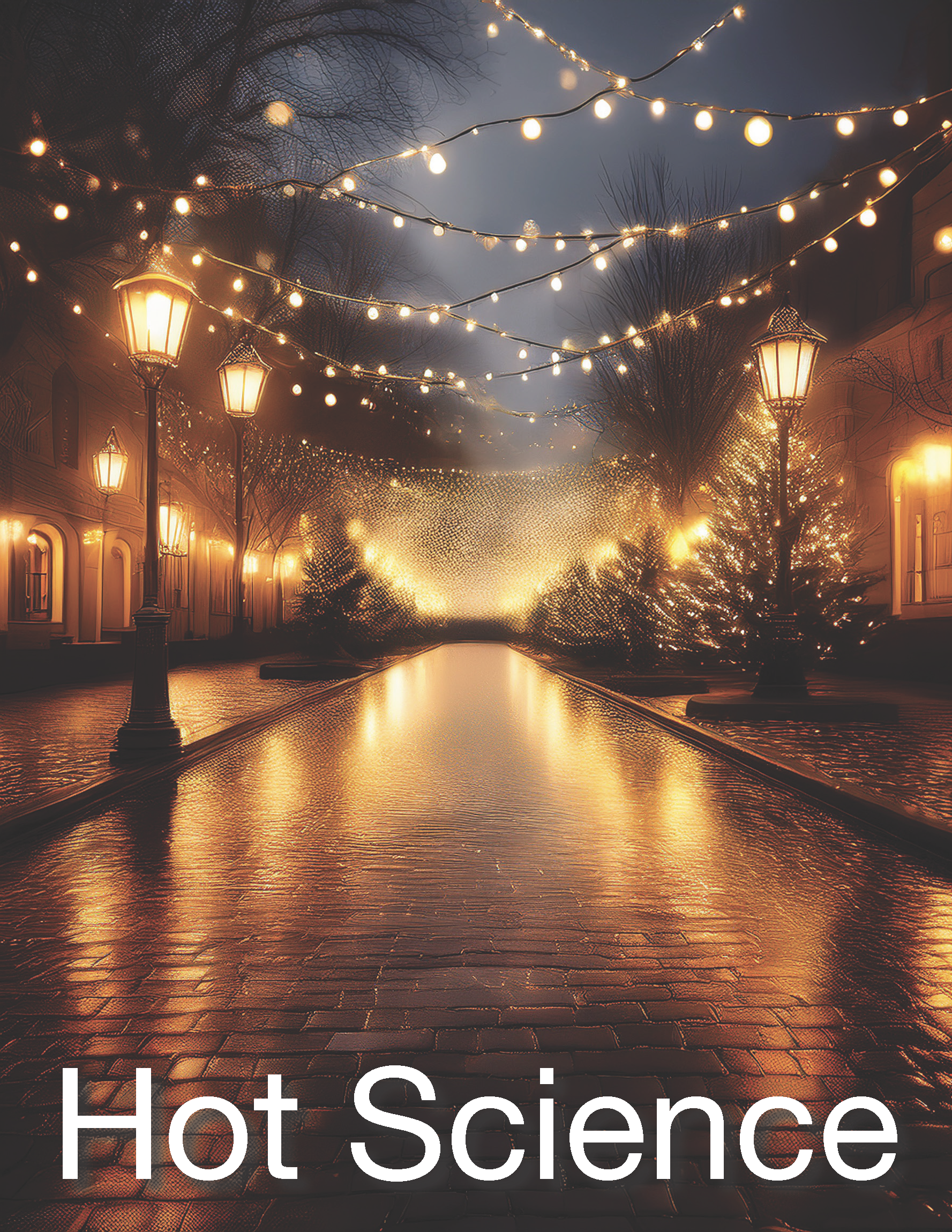
Christmas lights and sleepless nights: The science of holiday jet lag
Keywords:
Circadian rhythms, Blue light, Melatonin, LED lighting, Night-time sleepAbstract
In December, LED lights, screens, and garlands turn night into “day,” disrupting the circadian clock. This article explains, based on the neurobiology of melanopsin and melatonin, how blue light at night delays sleep and promotes “holiday jet lag”: more fatigue, cravings, and bad mood. It proposes simple “light hygiene” strategies (color, intensity, and timing) and two practical tools: a mini test and a home diary of light and sleep so that each reader can experiment at home.
References
Brainard, G. C., Hanifin, J. P., Greeson, J. M., Byrne, B., Glickman, G., Gerner, E., & Rollag, M. D. (2001). Action spectrum for melatonin regulation in humans: Evidence for a novel circadian photoreceptor. The Journal of Neuroscience, 21(16), 6405–6412. https://doi.org/10.1523/JNEUROSCI.21-16-06405.2001
Do, M. T. H. (2019). Melanopsin and the intrinsically photosensitive retinal ganglion cells: Biophysics to behavior. Neuron, 104(2), 205–226. https://doi.org/10.1016/j.neuron.2019.07.016
Lee, S., Matsumori, K., Nishimura, K., Nishimura, Y., Ikeda, Y., Eto, T., & Higuchi, S. (2018). Melatonin suppression and sleepiness in children exposed to blue-enriched white LED lighting at night. Physiological reports, 6(24), e13942. https://doi.org/10.14814/phy2.13942
Höhn, C., Hahn, M. A., Gruber, G., Cajochen, C., & Hoedlmoser, K. (2024). Effects of evening smartphone use on sleep and declarative memory consolidation in adolescents and young adults [Abstract]. Sleep Medicine, 115(Suppl 1), S53–S54. https://doi.org/10.1016/j.sleep.2023.11.183
AlShareef, S. M. (2022). The impact of bedtime technology use on sleep quality and excessive daytime sleepiness in adults. Sleep Science, 15(Special Issue 2), 318–327. https://doi.org/10.5935/1984-0063.20200128
Downloads
Published
How to Cite
Issue
Section
License
Copyright (c) 2025 Revista de divulgación científica iBIO

This work is licensed under a Creative Commons Attribution-NonCommercial-NoDerivatives 4.0 International License.
Self-archiving or deposit of the works in their post-publication version (editorial version) is permitted in any personal, institutional or thematic repository, social or scientific networks. The above applies from the moment of publication of the article in question on the website of the Revista de divulgación científica iBIO.