
Hidden contaminants in water: who can tackle them?
Keywords:
Emerging contaminants, bioremediation, diclofenacAbstract
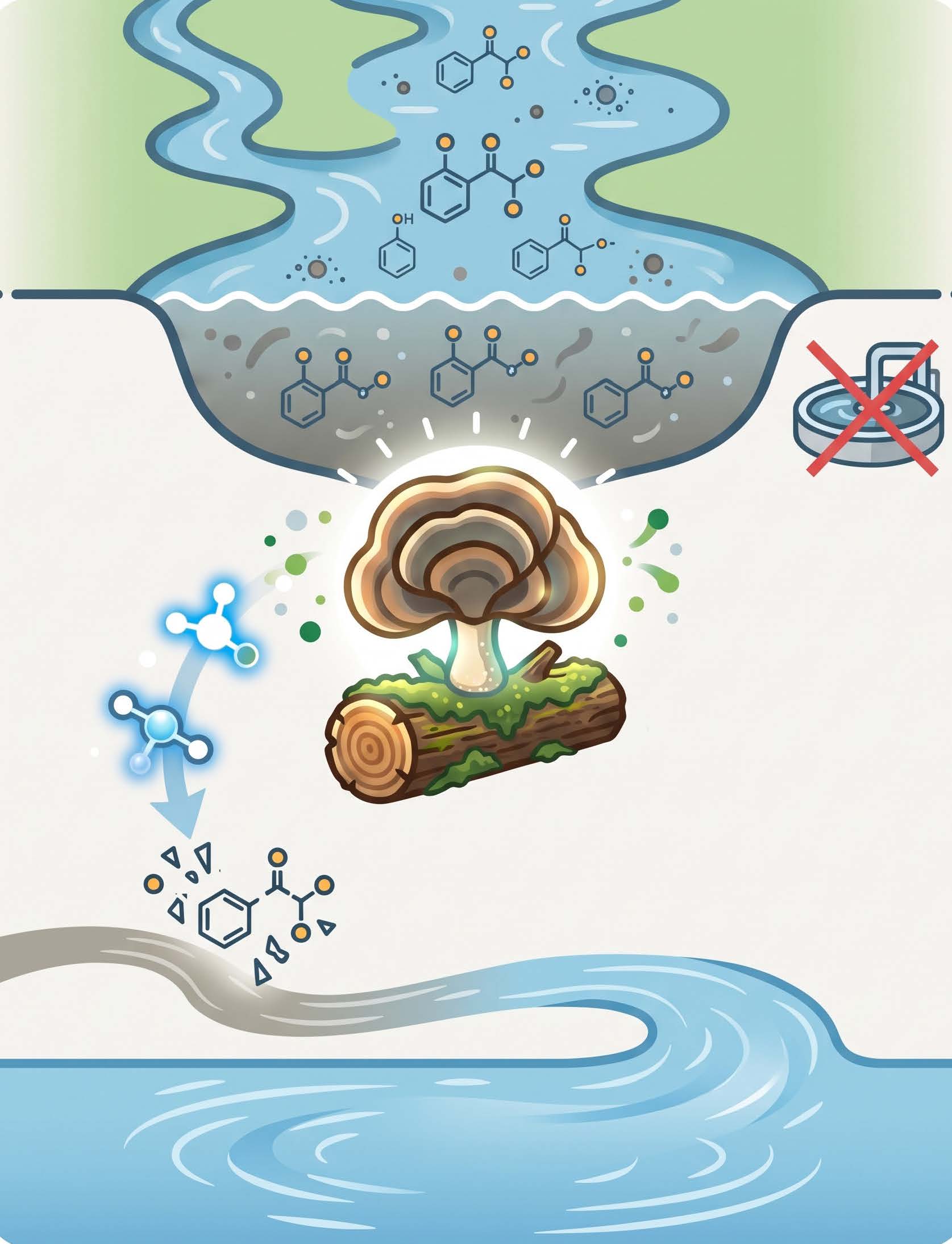
Did you know that the painkillers you take can end up in rivers and lakes without anyone detecting them? Diclofenac is one of thousands of compounds that reach water bodies in concentrations so small they go unnoticed, yet with real consequences for aquatic ecosystems. Conventional wastewater treatment plants were not designed to remove it, and existing alternatives are either costly or generate new problems. However, nature offers a surprising solution: a fungus commonly found in temperate forests, called Trametes versicolor, capable of degrading it efficiently and without generating toxicity.
References
Li, X., Shen, X., Jiang, W., Xi, Y., & Li, S. (2024). Comprehensive review of emerging contaminants: Detection technologies, environmental impact, and management strategies. Ecotoxicology and Environmental Safety, 278, 116420. https://doi.org/10.1016/j.ecoenv.2024.116420
Böger, B., Surek, M., de O Vilhena, R., Fachi, M. M., Junkert, A. M., Santos, J. M., & Pontarolo, R. (2021). Occurrence of antibiotics and antibiotic resistant bacteria in subtropical urban rivers in Brazil. Journal of Hazardous Materials, 402, 123448. https://doi.org/10.1016/j.jhazmat.2020.123448
Torres, A., Rodríguez, H. A., & Ayala, M. (2023). Contaminantes emergentes en México: panorama actual, retos y una posible solución biotecnológica. TIP. Revista especializada en ciencias químico-biológicas, 26. https://doi.org/10.22201/fesz.23958723e.2023.590
Acuña-Bedoya, J. D., Borja-Maldonado, F., Herrera-Domínguez, M., & Zavala, M. Á. L. (2025). Current situation of emerging contaminants in Mexican waters and treatment perspectives. Current Opinion in Environmental Science & Health, 46, 100636. https://doi.org/10.1016/j.coesh.2025.100636
Wojcieszyńska, D., Łagoda, K., & Guzik, U. (2023). Diclofenac biodegradation by microorganisms and with immobilised systems—a review. Catalysts, 13(2), 412. https://doi.org/10.3390/catal13020412
Bound, J. P., & Voulvoulis, N. (2005). Household disposal of pharmaceuticals as a pathway for aquatic contamination in the United Kingdom. Water Health, 3(4), 455–463. https://doi.org/10.1289/ehp.8315
Oviedo-Gómez, D. G. C., Galar-Martínez, M., García-Medina, S., Razo-Estrada, C., & Gómez-Oliván, L. M. (2010). Diclofenac-enriched artificial sediment induces oxidative stress in Hyalella azteca. Environmental Toxicology and Pharmacology, 29(1), 39-43. https://doi.org/10.1016/j.etap.2009.09.004
Dixon D. Turkeytail Fungus [fotografía]. Wikimedia Commons; 2023. Licencia CC BY-SA 2.0. Disponible en: https://commons.wikimedia.org/w/index.php?curid=132849101
Trejo-Caballero, M.E., Elizalde-Mata, A., Guardado-Ruíz, E., González-Reyna, M.A., & Estevez, M. (2026). Biomass for contaminant removal: A critical review of misconceptions, realities, and the lab-to-industry gap. Separation and Purification Technology, 394, 137431. https://doi.org/10.1016/j.seppur.2026.137431
Mir-Tutusaus, J. A., Parladé, E., Villagrasa, M., Barceló, D., Rodríguez-Mozaz, S., Martínez-Alonso, M., & Caminal, G. (2019). Long-term continuous treatment of non-sterile real hospital wastewater by Trametes versicolor. Journal of Biological Engineering, 13(1), 47. https://doi.org/10.1186/s13036-019-0179-y
Downloads
Published
How to Cite
Issue
Section
License
Copyright (c) 2026 Revista de divulgación científica iBIO

This work is licensed under a Creative Commons Attribution-NonCommercial-NoDerivatives 4.0 International License.
Self-archiving or deposit of the works in their post-publication version (editorial version) is permitted in any personal, institutional or thematic repository, social or scientific networks. The above applies from the moment of publication of the article in question on the website of the Revista de divulgación científica iBIO.