
Emerging nanoparticles as an alternative to agricultural pesticides
Keywords:
Nanoparticles, phytopathogens, pesticidesAbstract
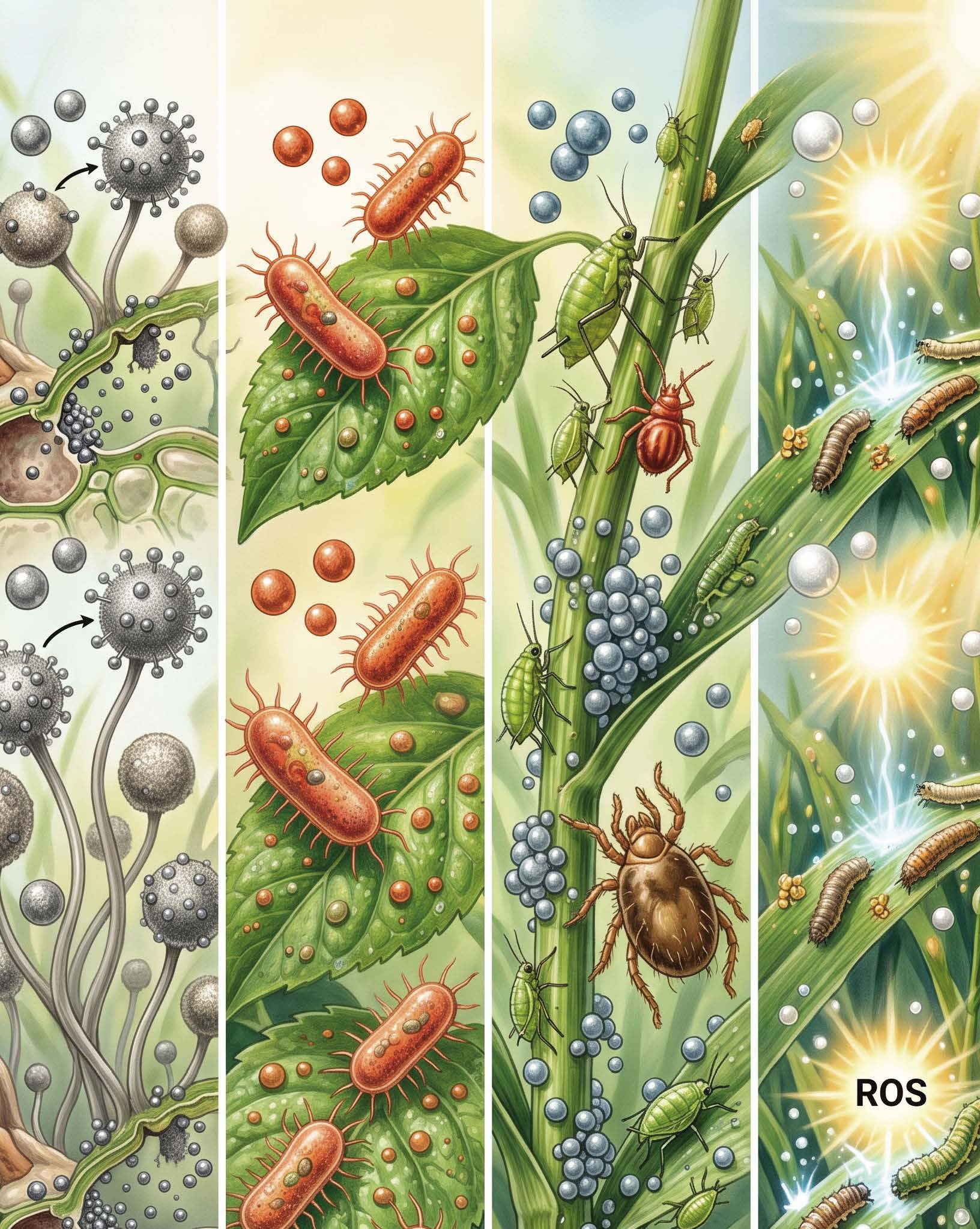
Currently, the global population has surpassed 8.09 billion, increasing the demand for agricultural production worldwide. Producing healthy, sufficient, and high-quality food requires a series of practices, ranging from soil preparation to the protection of crops against plant pathogens. To meet these demands, chemical pesticides have been widely used; however, their application has led to soil and groundwater contamination, affecting both the microbial ecosystem and the quality of agricultural products. In this review, we explore the pesticidal properties of silver, copper, zinc, and titanium nanoparticles, as well as their limitations and practical applications.
References
Jamiołkowska, A., (2020) Natural compounds as elicitors of plant resistance against diseases and new biocontrol strategies, Agronomy, 10, 2, 173 https://doi.org/10.3390/agronomy10020173.
Houng Wang, Muhammad Jafir, Muhammad Irfan, Tanveer Sdmad, Muhammad Zia-ur-Rehman, Muhammad Usman, Muhammad Rizwan, Yousef Alhaj Hamound, Hiba Shaghaleh., (2024) Emerging trends to replace pesticides with nanomaterials: Recent experiences and future perspectives for ecofriendly environment, Journal of Environmental Management 360, 121178. https://doi.org/10.1016/j.jenvman.2024.121178
Savary, S., Willocquet, L., Pethybridge, S. J., Esker, P., McRoberts, N., Nelson, A., (2019) The global burden of pathogens and pests on major food crops, Nat Ecol Evol, 3, 3, 430–439, https://doi.org/10.1038/s41559-018-0793-y.
Ashwini, K., Titilope, J.J., Popat, M., et. al., (2024) Sustainable and consumer-centric nanotechnology-based materials: An update on the multifaceted applications, risks and tremendous opportunities, Nano-Structures &Nano-Objects, 38, 101148. https://doi.org/10.1016/j.nanoso.2024.101148
Zishan, A., Shareen, N., Assima, F., et. al., (2024) Enhancing plant resilience: Nanotech solutions for sustainable agriculture. Heliyon, 10:23, e40735 https://doi.org/10.1016/j.heliyon.2024.e40735
Garibo, D., Borbón-Nuñez, H. A., de León, J. N. D., García Mendoza, E., Estrada, I., Toledano-Magaña, Y., et al. (2020). Green Synthesis of Silver Nanoparticles Using Lysiloma Acapulcensis Exhibit High-Antimicrobial Activity. Sci. Rep. 10, 12805–12811. doi:10.1038/s41598-020-69606-7
Nadiya, M.A., Muhammad A.I., et. al., (2023) Synthesis, characterization and antifungal potential of titanium dioxide nanoparticles against fungal disease (Ustilago tritici) of wheat (Triticum aestivum L.), Environmental Researcha, 28:1, 115852.
Grmay, H.L., Noémie, T., et. al., (2024) Linking the key physiological functions of essential micronutrients to their deficiency symtoms in plants, New Phytologist Fundation, 242:3, 881-902 https://doi.org/10.1111/nph.19645.
Adnan, R., Krisha, K., et. al., (2024) Exploring the potential of metallic and metal oxide nanoparticles for reinforced disease management in agricultural systems: A comprehensive review. Environ. Nanotechnol. Monit. Manag. 2, 100998. https://doi.org/10.1016/j.enmm.2024.100998.
González-Merino, A.M., Hernández-Juárez, A., et. al., (2021). Antifungal activity of zinc oxide nanoparticles in Fusarum oxysporum-Solanum lycopersicum pathosystem under controlled conditions, Journal of Phytopathology, 169:9, 533-544 https://doi.org/10.1111/jph.13023
Downloads
Published
How to Cite
Issue
Section
License
Copyright (c) 2026 Revista de divulgación científica iBIO

This work is licensed under a Creative Commons Attribution-NonCommercial-NoDerivatives 4.0 International License.
Self-archiving or deposit of the works in their post-publication version (editorial version) is permitted in any personal, institutional or thematic repository, social or scientific networks. The above applies from the moment of publication of the article in question on the website of the Revista de divulgación científica iBIO.