
La tríada dinámica: Prebióticos, probióticos y posbióticos
Palabras clave:
Probióticos, Prebióticos, PosbióticosResumen
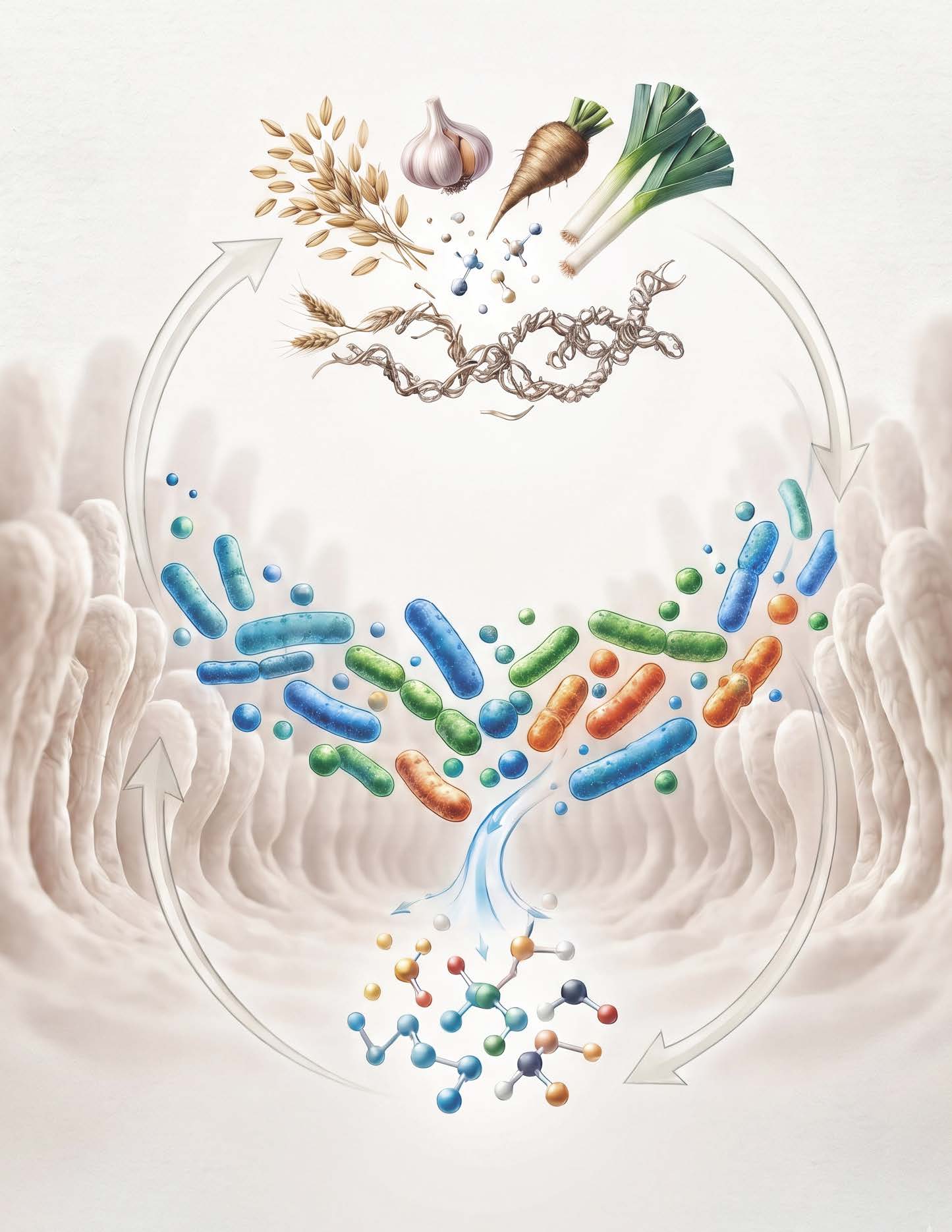
En nuestro cuerpo habitan billones de microorganismos —algunos son patógenos y otros benéficos— cuya armonía es vital para el bienestar. Esta comunidad no actúa de forma aislada; funciona a través de una tríada dinámica: los probióticos (microbios vivos) interactúan con los prebióticos (su combustible) para generar posbióticos (sustancias beneficiosas). Juntos, estos elementos regulan la digestión, fortalecen las defensas y estabilizan el metabolismo. Comprender esta relación marca un cambio de paradigma en la ciencia actual, permitiendo una nutrición de precisión capaz de diseñar estrategias personalizadas para prevenir enfermedades y potenciar nuestra salud integral a lo largo de la vida.
Citas
Dubois, L., Valles-Colomer, M., Ponsero, A., Helve, O., Andersson, S., Kolho, K.-L., Asnicar, F., Korpela, K., Salonen, A., Segata, N., & M de Vos, W. (2024). Paternal and induced gut microbiota seeding complement mother-to-infant transmission. Cell Host & Microbe, 32(6), 1011-1024. https://doi.org/10.1016/j.chom.2024.05.004
Ji, J., Jin, W., Liu, S.-J., Jiao, Z., & Li, X. (2023). Probiotics, prebiotics, and postbiotics in health and disease. MedComm, 4, e420. https://doi.org/10.1002/mco2.420
Smolinska, S., Popescu, F.-D., & Zemelka-Wiacek, M. (2025). A Review of the Influence of Prebiotics, Probiotics, Synbiotics, and Postbiotics on the Human Gut Microbiome and Intestinal Integrity. Journal of Clinical Medicine, 14(11), 3673. https://doi.org/10.3390/jcm14113673
Gupta, V., & Garg, R. (2009). Probiotics. Indian Journal of Medical Microbiology, 27(3), 202-9. https://doi.org/10.4103/0255-0857.53201
Hill, C., Guarner, F., Reid, G., Gibson, G. R., Merenstein, D. J., Pot, B., Morelli, L., Canani, R. B., Flint, H. J., Salminen, S., Calder, P. C., & Sanders, M. E. (2014). Expert consensus document: The International Scientific Association for Probiotics and Prebiotics consensus statement on the scope and appropriate use of the term probiotic. Nature Reviews Gastroenterology & Hepatology, 11(8), 506-514. https://doi.org/10.1038/nrgastro.2014.66
Gibson, G. R., Hutkins, R., Sanders, M. E., Prescott, S. L., Reimer, R. A., Salminen, S. J., Scott, K., Stanton, C., Swanson, K. S., Cani, P. D., Verbeke, K., & Reid, G. (2017). Expert consensus document: The International Scientific Association for Probiotics and Prebiotics (ISAPP) consensus statement on the definition and scope of prebiotics. Nature Reviews Gastroenterology & Hepatology, 14(8), 491-502. https://doi.org/10.1038/nrgastro.2017.75
Salminen, S., Collado, M. C., Endo, A., Hill, C., Lebeer, S., Quigley, E. M. M., Sanders, M. E., Shamir, R., Swann, J. R., Szajewska, H., & Vinderola, G. (2021). The International Scientific Association of Probiotics and Prebiotics (ISAPP) consensus statement on the definition and scope of postbiotics. Nature Reviews Gastroenterology & Hepatology, 18, 649-667. https://doi.org/10.1038/s41575-021-00440-6
Descargas
Publicado
Cómo citar
Número
Sección
Licencia
Derechos de autor 2026 Revista de divulgación científica iBIO

Esta obra está bajo una licencia internacional Creative Commons Atribución-NoComercial-SinDerivadas 4.0.
Se permite el autoarchivo o deposito de los trabajos en su versi´ón post-publicación (versión editorial) en cualquier repositorio personal, institucional o temático, redes sociales o científicas. Lo anterior aplica desde el momento de la publicación del artículo en cuestión en la página web de la Revista de divulgación científica iBIO.