
The dynamic triad: Prebiotics, probiotics, and postbiotics
Keywords:
Probiotics, Prebiotics, PostbioticsAbstract
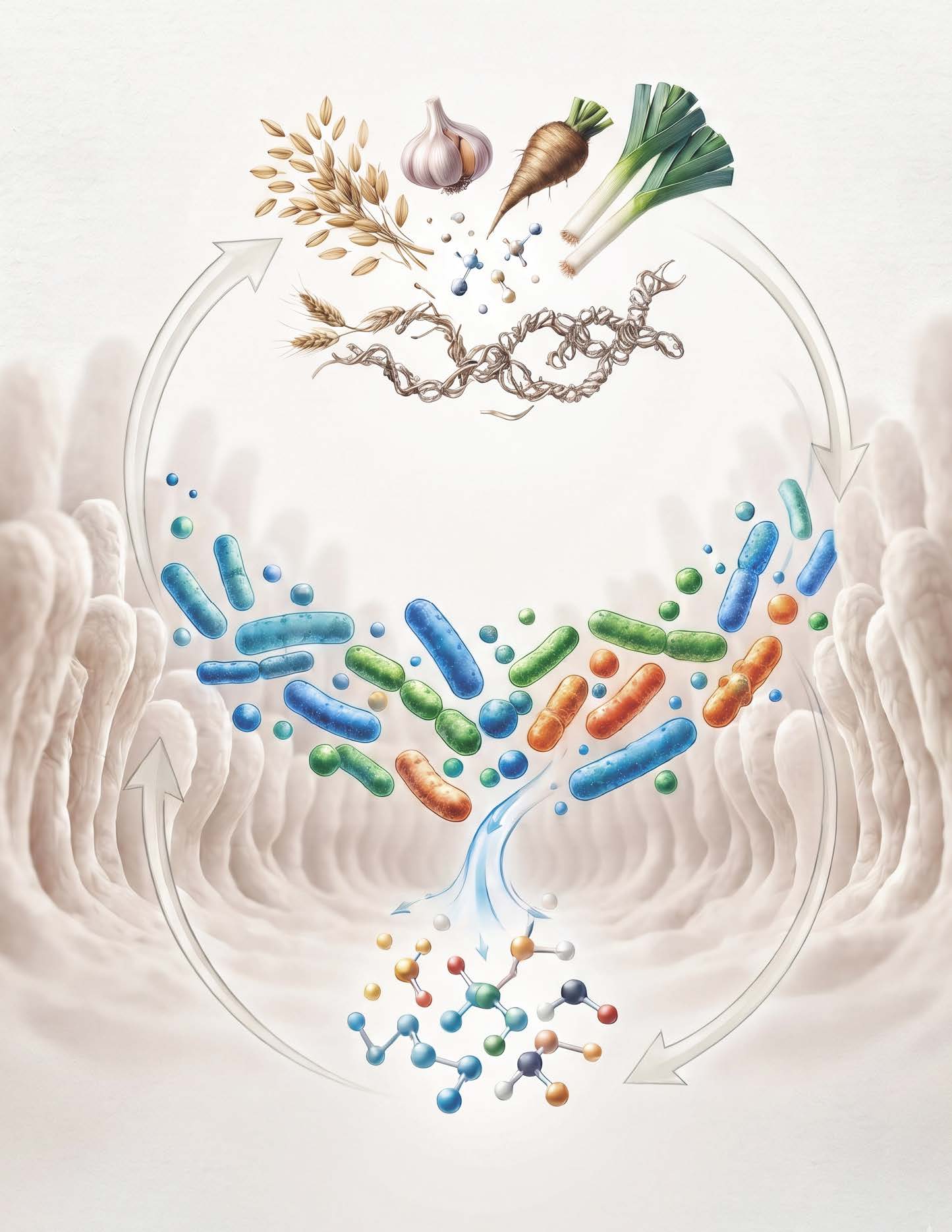
Our bodies are home to trillions of microorganisms —some pathogens and others beneficial— whose harmony is vital for our well-being. This community does not act in isolation; it functions through a dynamic triad: probiotics (live microbes) interact with prebiotics (their fuel) to generate postbiotics (beneficial substances). Together, these elements regulate digestion, strengthen immune defenses, and stabilize metabolism. Understanding this relationship represents a paradigm shift in modern science, enabling precision nutrition, an approach that tailors dietary strategies to each individual’s biological characteristics, lifestyle, and environmental factors, with the aim of preventing disease and promoting lifelong health and well-being.
References
Dubois, L., Valles-Colomer, M., Ponsero, A., Helve, O., Andersson, S., Kolho, K.-L., Asnicar, F., Korpela, K., Salonen, A., Segata, N., & M de Vos, W. (2024). Paternal and induced gut microbiota seeding complement mother-to-infant transmission. Cell Host & Microbe, 32(6), 1011-1024. https://doi.org/10.1016/j.chom.2024.05.004
Ji, J., Jin, W., Liu, S.-J., Jiao, Z., & Li, X. (2023). Probiotics, prebiotics, and postbiotics in health and disease. MedComm, 4, e420. https://doi.org/10.1002/mco2.420
Smolinska, S., Popescu, F.-D., & Zemelka-Wiacek, M. (2025). A Review of the Influence of Prebiotics, Probiotics, Synbiotics, and Postbiotics on the Human Gut Microbiome and Intestinal Integrity. Journal of Clinical Medicine, 14(11), 3673. https://doi.org/10.3390/jcm14113673
Gupta, V., & Garg, R. (2009). Probiotics. Indian Journal of Medical Microbiology, 27(3), 202-9. https://doi.org/10.4103/0255-0857.53201
Hill, C., Guarner, F., Reid, G., Gibson, G. R., Merenstein, D. J., Pot, B., Morelli, L., Canani, R. B., Flint, H. J., Salminen, S., Calder, P. C., & Sanders, M. E. (2014). Expert consensus document: The International Scientific Association for Probiotics and Prebiotics consensus statement on the scope and appropriate use of the term probiotic. Nature Reviews Gastroenterology & Hepatology, 11(8), 506-514. https://doi.org/10.1038/nrgastro.2014.66
Gibson, G. R., Hutkins, R., Sanders, M. E., Prescott, S. L., Reimer, R. A., Salminen, S. J., Scott, K., Stanton, C., Swanson, K. S., Cani, P. D., Verbeke, K., & Reid, G. (2017). Expert consensus document: The International Scientific Association for Probiotics and Prebiotics (ISAPP) consensus statement on the definition and scope of prebiotics. Nature Reviews Gastroenterology & Hepatology, 14(8), 491-502. https://doi.org/10.1038/nrgastro.2017.75
Salminen, S., Collado, M. C., Endo, A., Hill, C., Lebeer, S., Quigley, E. M. M., Sanders, M. E., Shamir, R., Swann, J. R., Szajewska, H., & Vinderola, G. (2021). The International Scientific Association of Probiotics and Prebiotics (ISAPP) consensus statement on the definition and scope of postbiotics. Nature Reviews Gastroenterology & Hepatology, 18, 649-667. https://doi.org/10.1038/s41575-021-00440-6
Downloads
Published
How to Cite
Issue
Section
License
Copyright (c) 2026 Revista de divulgación científica iBIO

This work is licensed under a Creative Commons Attribution-NonCommercial-NoDerivatives 4.0 International License.
Self-archiving or deposit of the works in their post-publication version (editorial version) is permitted in any personal, institutional or thematic repository, social or scientific networks. The above applies from the moment of publication of the article in question on the website of the Revista de divulgación científica iBIO.